Voice Agents
AI agents that handle phone calls like a live operator, follow your business rules, and log each outcome in your CRM or ERP
YYTECH builds voice agents and runs them on real customer calls, handling the telephony, speech recognition and synthesis, checks, and integrations. YYTECH voice AI is in operation in five projects: tire service, leasing, furniture retail, barbershops, and call analytics. Models run via API or on-premises.
- 5
- voice AI projects in operationper YYTECH; number of projects, not an efficiency metric
- ≈1 s
- response time, on-premisesrounded from the leasing agent measurement of Sep 23, 2026 (median 1.2 s)
- 10,000+
- call minutes a month transcribedper YYTECH; CRM telephony project, server without a GPU
- 52 of 53
- client scenarios passed in the latest runrun of Oct 22, 2026, leasing agent, test customer
The problem
Customers call after hours and at peak times, when operators are busy. Outbound calls about overdue payments, appointment confirmations, and deferred demand eat up staff time. Transcribing calls for analytics adds up quickly at per-minute provider rates.
A voice agent takes routine calls and leaves a record in the client’s system after each conversation: a request, a booking, or a promise to pay with a date and amount.
Where the agents work
Four typical scenarios: the first two run in live projects, and the other two are options built for a client’s task.
- Phone receptionist: answers questions, books the customer, and records the outcome in the CRM or booking system.
- Outbound calling: overdue payments, reactivation, and appointment confirmation; the agent records what was agreed.
- Voice assistant in a product: a voice interface to an app or internal system that answers from its data.
- Executive assistant: answers spoken questions about KPIs, variances, and summaries from the data mart.
| Project | Calls | What the agent does | Connected to |
|---|---|---|---|
| Tire center chain | inbound, 24/7 | tire selection, fitting and repair booking, callbacks, and transfer to front-desk staff | client’s PBX, CRM, booking calendar |
| Leasing company | outbound | calls about overdue payments: payment date, office visit, and call outcome for the ERP | ERP; on-premises on one GPU |
| Furniture store chain | inbound and outbound | four bots: store visit booking, booking confirmation, deferred demand, and cold leads | two separate phone networks, CRM, calendar; on-premises models |
| Barbershop chain | inbound | choice of branch, service, barber, and free slot | booking system |
| Company using CRM-integrated telephony | call recordings | transcription of 10,000+ minutes a month for analytics | CRM, server without a GPU |
How a call works
Five components stand between “hello” and the CRM record, and each is engineered for the client. They are telephony (number and PBX, recording, transfer to staff), understanding of natural speech, the client’s script and business rules, a natural voice, and outcome logging in the CRM, ERP, calendar, or Telegram. The agent double-checks dates, numbers, and amounts. On request, the call goes to front-desk staff; disputed cases go to a specialist. On-premises, the agent answers in about a second, with no awkward pauses; every conversation and its outcome are saved.
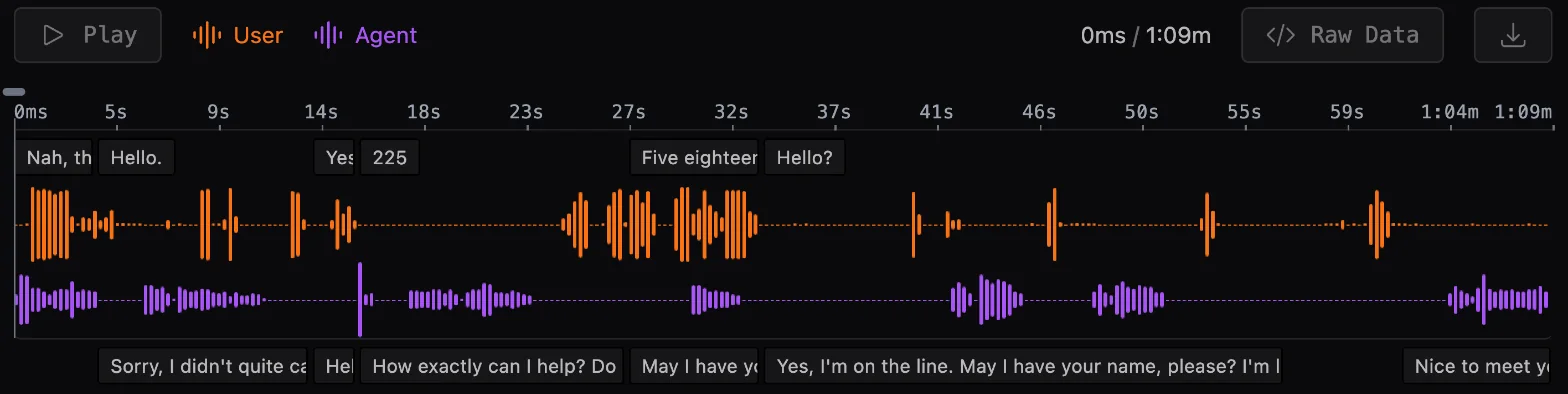
The caller should never feel they’re talking to a robot. A natural call takes more than a good voice. The agent waits for the end of a thought, not the first pause. When the caller starts talking, it stops at once and answers what was said. It speaks with natural intonation and pace and reads amounts, dates, and numbers as words. It remembers what was said, steers back after digressions, and stays calm when the caller is rude. When a customer thinks out loud (“Seven days… Hmm-hmm-hmm-hmm… La-la-la”), the agent waits and gently follows up: “Uh-huh. So, will that work?” YYTECH tunes and checks each of these traits on test conversations before the agent goes live.
Agents at work
Tire center. Calls go to the agent after hours and when the operators’ queue overflows. The agent runs four scenarios: tire selection with a request for a specialist, fitting and repair booking with a free-slot check, callbacks, and handoff to staff. It answers questions about delivery, payment, installments, warranty, and storage from the company’s fact sheet and then returns to the topic.
Leasing company. The agent works through a call list from the ERP and secures a date for full payment within seven days; if the customer can’t make it, the agent invites them to the office to sign a supplementary agreement. After the call, the ERP receives a clear outcome: one of twenty, with a date, amount, and reason. Examples include a promise to pay in full, an installment plan, an office visit, or an alternate contact. “Around the tenth” becomes a promise to pay on “September 10” with the amount taken from the contract data. When a customer dictates a phone number in chunks and with repeated digits, the agent pieces it together, checks it, and reads it back once without the country code.
Furniture stores. Four bots across two separate phone networks: store visit booking, booking confirmation, deferred demand, and cold leads. Eight production instances work with both phone networks, the CRM, and the calendar; models run on-premises, with no third-party APIs.
Speech analytics
Speech recognition, call outcomes, and rule checks also work on recordings of operators’ calls.
Already working in projects: transcription of 10,000+ call minutes a month from CRM telephony on a server without a GPU, with no platform fee for transcription; call outcomes in the ERP; and recording, transcript, and summary of every tire center call. The platform prototype adds request fields set by the business owner, Telegram alerts, and reports.
The same components can be used to build scoring of operators’ calls against a script checklist, topics and reasons for calls, search across transcripts, and summaries for managers.
Deployment
| Option | Where models run | Personal data | Response latency |
|---|---|---|---|
| On-premises | on the client’s infrastructure | stays inside the client’s infrastructure | 1.0–1.4 s |
| Dedicated server | on a server at a hosting provider | control stays with the client | 1.0–1.4 s |
| Third-party APIs | frontier models via API | anonymized before sending | 1.3–1.7 s |
The leasing agent runs entirely on one server with one GPU, with no external APIs. The tire center uses a hybrid: some models run on a self-hosted server, and the language model runs via API. Deciding where the models run before the project starts makes personal-data paperwork simpler. Latency ranges are typical values from YYTECH projects.
Quality
For the leasing agent, YYTECH maintains a specification page the client reads and comments on right in the text: 200 client decisions, versions, and published dialogues. Before release, the agent goes through conversations from the client’s scenarios, both regular and difficult: refusals, disputes, and wrong numbers. A language model plays the customer, and every conversation is checked automatically. Latest runs: leasing, 52 of 53 client scenarios; tire center, 6 of 6 check scenarios.
Platform: a bot from the owner’s requirements
For a telecom operator’s hackathon, YYTECH built a voice platform prototype. The owner describes the business in text or by voice and attaches a price list; a set-up agent clarifies details and prepares the bot’s behavior. A new version goes live only after checks; versions and rollback are built in. The owner calls the bot from the browser and sees the transcript, summary, and request fields. A simple lead qualification bot is built in about 5 minutes; a complex agent is still a custom project.
At night, while the GPUs are free from calls, the platform reviews the day’s conversations, turns difficult cases into test scenarios, checks improvements, and sends the owner a morning report. The owner chooses whether improvements are published automatically or after approval. In the prototype, the nightly cycle was completed on one example.
Summary
With a YYTECH voice agent, each call ends with a record in the client’s system. Five projects are in operation, models run via API or entirely on-premises, the agent goes through the client’s scenarios before release, and a platform prototype lets a business owner build their own bot.